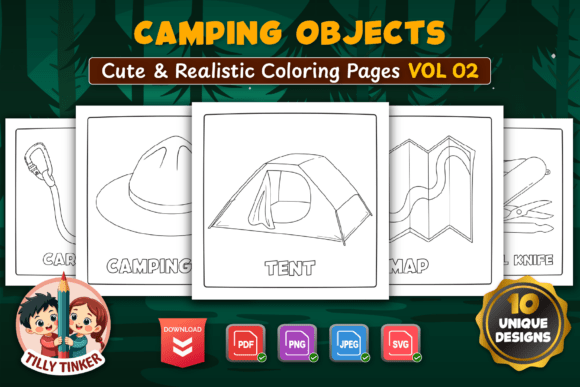
Camping Objects Coloring Pages Vol 02
A Designer’s First Look: Clean, Quiet, and Full of Craft Potential
When I opened Camping Objects Coloring Pages Vol 02, my first thought wasn’t “cute” or “trendy”—it was “usable.” As someone who turns line art into stitched reality every week, I immediately scanned for what matters most: consistent line weight, intentional negative space, and breathing room between elements. These aren’t busy illustrations crammed with shading or tiny flourishes. They’re hand-drawn, black-and-white outlines—simple, confident, and purpose-built for translation. The mood is warm but grounded: think campfire stories over marshmallows, not influencer glamping. That tone carries straight into embroidery—it reads as handmade, sincere, and quietly versatile.
From Page to Stitch: How It Holds Up on Real Projects
Last month, I tested three designs from Camping Objects Coloring Pages Vol 02 on a custom embroidered canvas tote for a local outdoor gear shop. We chose the tent, compass, and camp mug motifs—scaled to 3.5" wide—and digitized them as clean running-stitch outlines with subtle satin-stitch accents on key curves (like the mug handle). On medium-weight canvas with tear-away stabilizer, the results were crisp, legible, and unmistakably hand-crafted—not digital or generic. Customers noticed. One even asked if the artist had drawn them onsite at a recent trail festival.
That same batch worked well on organic cotton baby onesies (using soft cut-away stabilizer), tea towels (with gentle fill-stitch interiors for texture), and unstructured twill caps (where we simplified the compass to outline-only to avoid puckering on the curved crown). The line simplicity shines in these contexts: no dense fill areas to overwhelm lightweight fabric, no fragile interior details that vanish under stitching, and no fine crosshatching that turns muddy on textured surfaces.
Where to Lean In—and Where to Pause
Camping Objects Coloring Pages Vol 02 excels in personalization and small-batch production—but it’s not plug-and-play for every surface. On stretchy fabrics like ribbed knit sweatshirts, I recommend simplifying inner lines (e.g., removing the inner pole detail on the tent) and using a light fusible + tear-away stabilizer combo. On dark fabric, test thread color contrast early: a single strand of ecru or oatmeal thread reads beautifully against charcoal heather, but black-on-black disappears unless you add a white underlay stitch (which increases stitch density).
For curved or layered applications—think baseball caps, apron pockets, or pillow gussets—avoid motifs with tight interior corners (like the folded flap on the sleeping bag design) unless you’re willing to manually adjust the stitch path. And while the collection avoids tiny lettering entirely (a relief), double-check any implied text-like elements (e.g., a subtle “trail” curve in the path motif) before finalizing for commercial embroidery—those can blur at sub-2" scale.
What This Means for Your Craft Business
If you sell on Etsy or run a small shop, Camping Objects Coloring Pages Vol 02 isn’t just clipart—it’s quiet brand equity. Its understated style reads as intentional, not algorithm-chosen. When stitched onto a linen kitchen towel or an unbleached cotton tote, it signals care, authenticity, and attention to craft—not mass production. That builds customer trust, especially among buyers who pay more for handmade presentation and thoughtful design assets.
I’ve used motifs from this volume in holiday gift bundles (embroidered patch + printable coloring sheet), nursery decor sets (tent + pine tree + hiking boot on muslin wall hangings), and even wedding favors (mini embroidered napkins with the compass motif). Each time, the simplicity translated cleanly into finished product value—no over-engineering required.
Practical Notes Every Embroidery Designer Should Keep Handy
- Always test on scrap fabric first—especially when pairing with textured or dark materials. What reads clearly on screen may soften or disappear after stitching.
- Review stitch density in your digitizing software. Since these are line-based Coloring Pages, avoid adding unnecessary fill unless it serves function (e.g., grounding a patch shape).
- Confirm hoop size compatibility. Most motifs scale comfortably between 2.5"–4.5", but verify before digitizing for small hoops (under 3") or large-format projects.
- Inspect small details at actual stitch size. That delicate camp stove knob? At 1.8", it may become a single dot—consider simplifying or omitting for apparel use.
- Test black-and-white mockups on both light and dark backgrounds to anticipate how thread colors will interact with your base fabric.
- Use proper stabilizer for your fabric type—cut-away for knits, tear-away for stable wovens, and fusible + tear-away for lightweight linens.
- Check licensing terms before selling finished items or bundling as part of a digital embroidery file pack. Since Camping Objects Coloring Pages Vol 02 is categorized as Graphics, confirm whether commercial use is included for physical products and/or resale of derivative designs.
Final Thought: A Thoughtful Tool, Not Just Another Download
Camping Objects Coloring Pages Vol 02 won’t shout from a crowded craft fair table—but it will hold its ground. It’s the kind of design asset that earns repeat customers because it looks equally at home on a child’s backpack, a boutique apron, or a limited-run holiday sweatshirt. It doesn’t try to do everything. It does one thing well: offer clean, cohesive, camping-themed line art that translates faithfully into stitched texture, personality, and quiet professionalism. For designers, sellers, and makers who value clarity over clutter, it’s not just usable—it’s reliable.