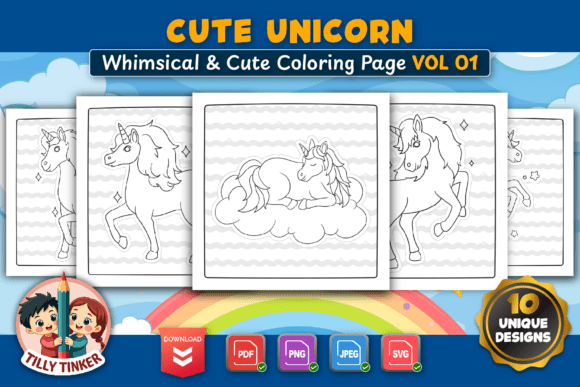
Cute Unicorn Coloring Pages Vol 01
First Impressions: Whimsy That Stitches Well
Opening Cute Unicorn Coloring Pages Vol 01, I immediately notice what makes it stand out for embroidery work: clean, confident line work with breathing room. These aren’t over-rendered illustrations—they’re hand-drawn outlines built for translation into stitch. The unicorns have soft curves, expressive eyes, and just enough magical detail (a swirl of horn, a few star accents, gentle mane flow) to read clearly at small scales. No tiny crosshatching or micro-shading that would vanish under satin stitch or blur on cotton twill. That simplicity isn’t a limitation—it’s intentional design discipline.
A Real Project Test: Embroidering a Baby Gift Set
Last week, I prepped a custom baby gift set for a client: a muslin swaddle, organic cotton onesie, and linen bib—all destined for hand-stitched embroidery using Cute Unicorn Coloring Pages Vol 01 as the base. I traced one unicorn illustration onto transfer paper, then digitized it as a machine embroidery design with balanced fill stitch density and subtle running stitch accents for the horn and tail tips. On the onesie? It held up beautifully—no puckering, no thread breakage. On the lightweight muslin? A light tear-away stabilizer kept everything crisp. The result felt handmade, not mass-produced: tender, joyful, and unmistakably *designed*—not just copied from a coloring book.
Where This Design Shines (and Where It Needs Care)
Cute Unicorn Coloring Pages Vol 01 excels in projects where charm and clarity matter more than photorealism:
- Embroidered patches—the bold outlines translate cleanly into satin-stitched edges, and the shape fits comfortably within standard 3"–4" hoops;
- Tote bag designs—scaled up to 5", the unicorn reads instantly, even from across a craft fair table;
- Sweatshirt embroidery—on midweight fleece, the open negative space prevents stiffness and keeps the garment wearable;
- Baby embroidery—soft lines avoid harsh contrast, making it ideal for nursery decor, burp cloths, or personalized blankets;
- Holiday embroidery—pair it with subtle glitter thread or pale pink bobbin work for a gentle, inclusive magic that avoids seasonal cliché.
But be thoughtful in these situations:
- Stretchy fabric—like jersey or ribbed knit—requires cut-away stabilizer and slower stitching speed. The design’s smooth curves can distort if tension isn’t dialed in.
- Dark fabric—light-colored thread will pop, but test contrast first. A single-color version in white-on-navy looks elegant; pastel-on-charcoal may fade visually.
- Curved surfaces—caps or curved pillow covers need careful hooping and possibly reduced density to prevent pull distortion.
- Frequent-wash items—like tea towels or kids’ aprons—stick to tightly digitized fill stitches and avoid ultra-thin outlines that fray over time.
What It Adds to Your Finished Product
This isn’t just decoration—it elevates perception. When customers see an embroidered tote bag using Cute Unicorn Coloring Pages Vol 01, they don’t see “a unicorn.” They see intention: a designer who chose warmth over flash, readability over clutter. That builds trust. For Etsy sellers and small shop owners, that translates directly into perceived value—handmade product buyers pay more for pieces that feel considered, not assembled. It also supports brand consistency: whether you’re stitching a batch of nursery pillows or launching a boutique line of embroidered kitchen towels, this design carries a cohesive, gentle fantasy tone without leaning into kitsch.
Practical Designer Notes Before You Stitch
Before digitizing or stitching Cute Unicorn Coloring Pages Vol 01, do these five things:
- Test on scrap fabric—especially if you’re using textured weaves like linen or terry cloth. Outline how the unicorn’s horn or ear details hold up.
- Check thread color contrast—try your top thread against both light and dark mockups. Sometimes a soft lavender reads better than stark white on ecru canvas.
- Review stitch density—if converting to a machine embroidery design yourself, keep fill areas open enough to drape naturally on apparel but dense enough to cover fabric completely on patches.
- Confirm hoop size early—most unicorns in this volume fit comfortably in a 4×4 hoop, but double-check before digitizing complex versions with added stars or clouds.
- Verify licensing—as a Graphics product intended for Coloring Pages use, confirm whether commercial embroidery rights are included before selling finished embroidered items or digital embroidery files.
Not Just for Kids—A Quietly Versatile Asset
Don’t box this into “baby section only.” I’ve used one of the simpler unicorns as a subtle logo accent on a small-batch apron line for herbalists—reduced to 1.25", stitched in oatmeal thread on natural canvas. It reads as artisanal, not juvenile. Another client used it as part of a wedding gift set: embroidered on linen napkins alongside monogrammed initials. The key is restraint—let the drawing’s quiet confidence speak for itself. It works because it doesn’t shout. It invites.
Final Thought: A Design That Respects the Craft
Cute Unicorn Coloring Pages Vol 01 feels like a collaborator—not a shortcut. It respects the time and skill required in embroidery work by giving you strong foundational shapes, emotional resonance, and real-world adaptability. Whether you’re digitizing for a client’s custom sweatshirt order, prepping for a holiday craft fair, or building a cohesive line of printable mockups for your Etsy shop, this set delivers usable, human-centered design—not just pretty lines on a page. That’s rare. And that’s why it earns shelf space in my working library.