My Axolotl Ate My Homework SVG: Graphics for Playful T-Shirt Designs
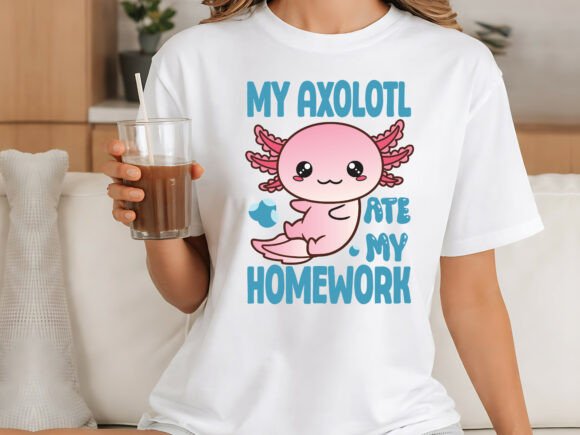
As a graphic designer who’s built brand identities for indie bookshops, launched Etsy product lines, and art-directed seasonal campaigns for handmade businesses, I opened My Axolotl Ate My Homework SVG expecting whimsy—and found something more valuable: intentional visual storytelling with commercial flexibility. This isn’t just clipart; it’s a cohesive illustration that lands squarely between charming absurdity and design-ready polish. The axolotl is rendered with soft outlines, expressive eyes, and a cheeky tilt—its mouth slightly agape around a crumpled paper corner. There’s no clutter, no forced shading, no over-rendered texture. Just clean vector lines, balanced negative space, and a subtle sense of narrative momentum.
A Mood That Fits Real Client Projects—Not Just Stock Imagery
I recently reviewed this asset while developing visuals for “Learner’s Lagoon,” a small-batch stationery brand launching a back-to-school capsule collection targeting educators, homeschool families, and creative teens. Their voice is warm, irreverent, and deeply human—not corporate, not cutesy, but authentically playful. My Axolotl Ate My Homework SVG immediately resonated as a unifying motif: it’s smart enough to avoid infantilizing, lighthearted enough to disarm, and visually distinct enough to anchor a full brand system. It leans into modern design without sacrificing approachability—a rare balance in today’s saturated creative marketplace.
Where It Shines Across Real-World Applications
In practice, this graphic design asset performs exceptionally well across multiple touchpoints:
- T-shirt design: Scales beautifully from youth small to adult 3XL; the bold silhouette reads instantly on fabric, even at 8” width.
- Sticker design & product mockups: Crisp edges hold up on die-cut vinyl, and the transparent background (confirmed in PNG version) layers cleanly over textured packaging or pastel backgrounds.
- Social media graphics: Works as a focal icon in Instagram carousels, Pinterest pins, and Canva templates—especially when paired with handwritten fonts or friendly sans serifs like Poppins or Quicksand.
- Cricut project & sublimation design: Vector-based SVG file imports flawlessly into Design Space; no pixelation, no alignment issues, no need for manual path cleanup.
- Printable design & editorial design: Its clean layout makes it ideal for themed activity pages, teacher resource bundles, or low-content journal interiors—yes, it was originally designed for KDP, but its versatility extends far beyond that niche.
Strategic Placement: Hero Graphics vs. Supporting Elements
This illustration thrives where personality matters most. Use it as a hero graphic on landing pages, feature banners, or tote bag front panels. It elevates product mockups—especially for mugs, notebooks, and enamel pins—by adding instant narrative warmth. As a decorative accent, it works elegantly in corners of digital ads or as repeating motifs in packaging design. For themed collections (e.g., “Science Humor” or “Study Break Essentials”), it serves as a reliable anchor across stickers, t-shirt designs, and printable wall art.
Where Caution Is Needed—Design Integrity First
That said, My Axolotl Ate My Homework SVG isn’t universally deployable. Avoid placing it in cramped layouts—its charm depends on breathing room. It struggles on complex or busy backgrounds unless you add a subtle drop shadow or solid shape behind it. In minimalist branding systems (think monochrome luxury skincare or corporate training materials), it risks feeling tonally dissonant. And while it’s excellent for small business branding, it shouldn’t replace core logo design—it’s a supporting element, not a primary mark.
What It Does for Brand Perception—Beyond Aesthetics
This asset subtly strengthens visual trust. Its consistent line weight and thoughtful proportions signal professional execution—not amateur clipart. That builds audience engagement: viewers pause, smile, remember. For a creative marketplace seller or print-on-demand brand, that emotional resonance translates directly into click-throughs and cart conversions. It also reinforces brand consistency when used across touchpoints—same axolotl, same energy, same joyful defiance of academic stress.
Practical Designer Notes Before You Commit
Before embedding My Axolotl Ate My Homework SVG into a client deliverable, run these checks:
- Test it in black and white—does the shape still read clearly? (It does.)
- Preview on both light and dark backgrounds—verify contrast meets WCAG AA standards for accessibility.
- Scale it down to 1.5” wide: check legibility of fine details (the paper crinkle holds up well).
- Place it on real product mockups—not just flat previews—to assess visual weight and proportion.
- Confirm commercial license covers your use case: yes, it permits use in physical merchandise, digital products, and client work—as long as you’re not reselling the SVG itself.
- Compare font pairings: it sings with rounded sans serifs and gentle scripts, but clashes with rigid serifs or aggressive display fonts.
- Inspect the SVG code—if you need to recolor or adjust paths, ensure it’s layered logically (it is: axolotl, paper, and shadow are separate groups).
Final Verdict: A Thoughtful Addition to Your Creative Toolkit
My Axolotl Ate My Homework SVG isn’t a trend-chasing novelty. It’s a well-crafted, commercially viable graphic design asset that solves real problems: injecting levity into educational products, adding character to handmade business branding, and delivering immediate recognition in crowded digital feeds. Whether you’re building an Etsy product suite, designing for a local science fair, or crafting social media graphics for a tutoring startup, this illustration brings cohesion, clarity, and quiet confidence. It doesn’t shout—it winks. And in today’s oversaturated visual landscape, that kind of intelligent restraint is exactly what makes a design asset worth keeping.