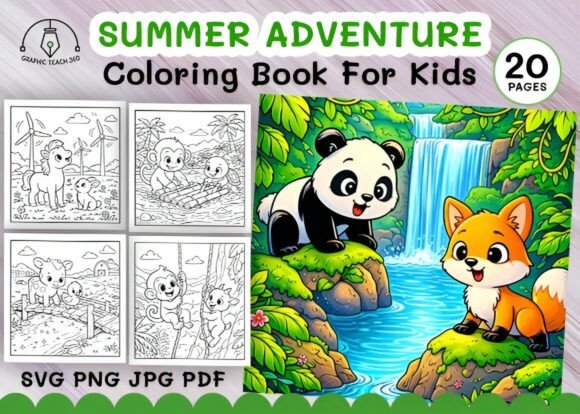
Summer Adventure Coloring Book for Kids
A Designer’s First Glance: Bold, Friendly, and Ready for Stitching
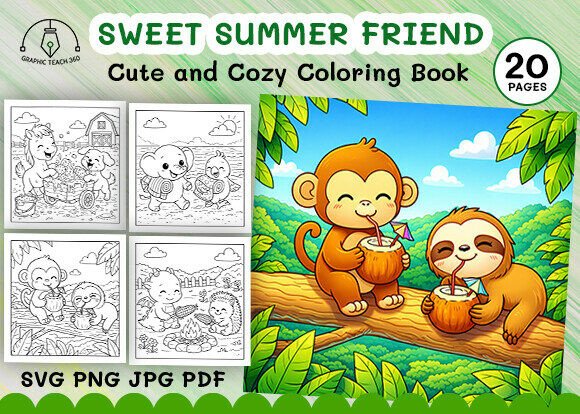
Opening Summer Adventure Coloring Book for Kids, I immediately notice what makes it stand out in a crowded digital design marketplace: confident line weight, generous negative space, and a joyful, unhurried rhythm. These aren’t fussy illustrations — they’re intentionally bold and easy coloring pages built around animal friends hiking, splashing in water, and lounging under sun-dappled trees. As an embroidery designer who’s stitched hundreds of kids’ designs onto onesies, totes, and tea towels, I appreciate how the clean outlines and simplified shapes translate directly to stitch-friendly silhouettes. This isn’t just a coloring book — it’s a set of natural embroidery-ready graphics.
Real Project Test: A Custom Embroidered Tote for a Local Summer Camp
Last week, I prepped a small batch of canvas tote bags for a neighborhood summer camp. The goal? Lightweight, cheerful, washable, and instantly recognizable as “camp fun.” I chose one of the fox-and-kayak pages from Summer Adventure Coloring Book for Kids and digitized it into a 3.5" machine embroidery design. What worked beautifully: the thick outer lines held up crisply on medium-weight canvas with tear-away stabilizer; the open interior spaces avoided dense fill stitch buildup; and the friendly scale meant kids could spot the design from across the playground. Parents commented on how “clear” and “happy” it looked — not busy, not babyish, not overly cutesy. That’s the quiet strength of this collection: it lands right in the sweet spot between playful and polished.
Where It Shines (and Where to Pause)
Summer Adventure Coloring Book for Kids excels on:
- Custom apparel — especially sweatshirts, crewneck tees, and reversible bucket hats. The simplified forms read well at 3–4" sizes without losing character.
- Embroidered patches — the bold contours stitch cleanly as satin-stitched edges, and the minimal internal detail keeps stitch count manageable for iron-on or sew-on versions.
- Baby embroidery — think bibs, burp cloths, and soft cotton onesies. Gentle curves and rounded features feel safe and soothing, not overwhelming.
- Kitchen and nursery decor — tea towels, pillow covers, and framed hoop art benefit from the design’s visual breathing room and thematic warmth.
- Etsy listings and craft fair products — because the theme is seasonal but not dated, and the style feels handmade without looking amateurish.
Use with thoughtful attention on:
- Small hoop sizes (under 3") — some of the more detailed pages (like the turtle with shell patterns) may lose legibility. Stick to the simplest animal outlines for tiny placements.
- Stretchy or thin fabric — like jersey or lightweight cotton voile. These need extra stabilizer support, and fine interior lines might distort. Prioritize pages with strong outer shapes and minimal interior linework.
- Dark fabric backgrounds — while the bold lines help, test thread color contrast early. A light ecru or pale yellow works better than stark white on navy or charcoal.
- Curved surfaces — like caps or baby bonnets. Choose centered, symmetrical motifs (a single bear holding a popsicle, for example) over wide horizontal scenes that warp across seams.
- Frequent-wash items — avoid ultra-thin connecting lines or tiny floating elements (e.g., individual flower petals). Opt for grouped, anchored shapes that hold structural integrity after laundering.
What It Adds to Your Finished Product — Beyond Just Looks
When you choose Summer Adventure Coloring Book for Kids for a handmade product, you’re not just picking a motif — you’re selecting a tone. Customers respond to its sincerity. It reads as intentional, not algorithm-generated. On a personalized gift — say, a linen pillow cover monogrammed with a child’s name and a matching raccoon from the bundle — the design elevates perceived value. It doesn’t scream “mass-produced clipart.” It says, “This was chosen with care.” That builds trust, especially for Etsy sellers and boutique owners whose buyers prioritize authenticity.
For craft businesses, the cohesive summer theme supports branding consistency across product lines: same animal motif on a tote, a matching embroidered patch on a denim jacket, and a subtle repeat pattern on a printable mockup for social media. And because these are coloring pages first, they also double as versatile design assets — great for layered digital embroidery files where you stitch the outline, then let the customer add their own colored thread fills or fabric paint accents.
Practical Notes Every Embroidery Designer Should Check
Before stitching your first project with Summer Adventure Coloring Book for Kids:
- Test on scrap fabric — especially if using textured weaves or blends. See how the bold lines register with your needle and thread tension.
- Review stitch density in any fill areas. Even “easy” coloring pages can become dense when converted to embroidery — adjust underlay or reduce fill angle if needed.
- Confirm hoop size compatibility. Some pages may span wider than standard 4x4 hoops — check dimensions before digitizing.
- Inspect small details: eyes, paws, leaf tips. Can they be cleanly stitched at your target size? If not, simplify or omit rather than risk fuzzy results.
- Try black-and-white mockups. Does the shape still read clearly without color cues? Strong silhouette = stronger embroidery.
- Compare light and dark background options. What thread palette feels most natural? Earth tones, sky blues, and warm yellows tend to harmonize best with the collection’s mood.
- Use appropriate stabilizer — cutaway for knits, tear-away for stable wovens, and lightweight fusible for delicate linens.
- Verify licensing terms. Since this is a Graphics bundle marketed for coloring, confirm whether commercial use — especially for finished embroidered products sold online or at markets — is explicitly permitted.
In short: Summer Adventure Coloring Book for Kids isn’t flashy — and that’s why it’s reliable. It’s the kind of design that stitches true, sells well, and makes your handmade product feel thoughtfully made, not hurriedly assembled. For embroidery designers building a real craft business — not just collecting files — that distinction matters every single stitch.