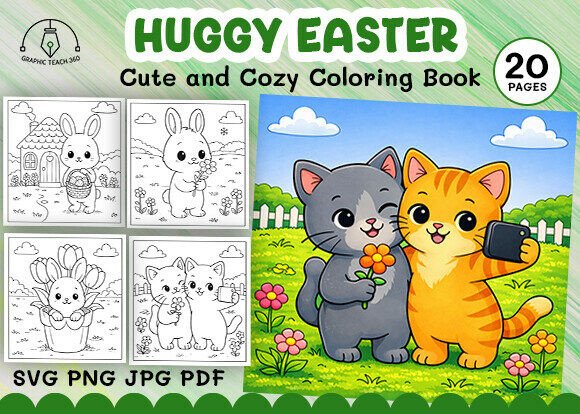
Huggy Easter Coloring Book
First Impressions: Soft Joy, Not Fussy Detail
Opening Huggy Easter Coloring Book, I didn’t see “just another Easter graphic”—I saw a mood that translates beautifully to stitch: warm, unhurried, and gently expressive. The line art is intentionally simple—bold outlines, generous negative space, rounded shapes, and minimal internal detail. That’s not a limitation; it’s design intelligence. For embroidery, especially on apparel or home goods, this means fewer stitch jumps, cleaner satin edges, and breathing room for fabric texture to show through. Think of a baby onesie with a bunny hugging a chick—the curves read instantly at 3 inches tall, no squinting required.
A Real Project Test: Embroidering the Tote Bag Moment
Last week, I prepped a custom order: an organic cotton tote for a local boutique’s Easter pop-up. Their brief? “Friendly, not fussy. Grandma-approved, kid-adorable.” I pulled up Huggy Easter Coloring Book and chose the fox-and-lamb hug motif. Why? Because on a 6” x 7” tote panel, the clean lines held integrity even when scaled down to 4.5”. No thin stems vanished in fill stitch. No tiny ears got lost in thread density. And crucially—it stitched cleanly on medium-weight canvas with tear-away stabilizer and standard 40wt polyester thread. Customers don’t buy “good digitizing”—they feel the difference when a design looks hand-drawn, not machine-perfect.
Where It Shines (and Where to Pause)
Huggy Easter Coloring Book excels in projects where warmth and legibility matter more than precision realism:
- Custom apparel: Sweatshirt cuffs, t-shirt chest pockets, and apron corners—its soft contours soften the formality of stitching.
- Baby embroidery: Onesies, burp cloths, and crib blankets benefit from its low-detail safety—no tiny loops that snag or frustrate little fingers.
- Embroidered patches: As a sew-on or iron-on, the bold outlines anchor well, and the open shapes minimize bulk.
- Kitchen textiles: Tea towels and oven mitts gain cheerful personality without visual clutter—even after 20+ washes, the shape stays recognizable.
- Personalized gifts: A name + one hugging animal motif on a pillow cover reads as thoughtful, not generic.
But be mindful: this isn’t a design for micro-detail work. Avoid using it on caps or curved surfaces where tight corners distort line flow. On dark fabric, test contrast early—some motifs rely on outline weight rather than interior shading, so light thread may need a white underlay. And skip dense layered garments like fleece-lined hoodies unless you reduce stitch density manually—those generous curves can trap heat and stiffness if overfilled.
What It Does for Your Craft Business
As an Etsy seller and small shop owner, I judge designs by how they affect three things: customer trust, perceived value, and repeat appeal. Huggy Easter Coloring Book builds trust because it looks handmade—not stock, not rushed. Its simplicity signals care, not compromise. That matters when pricing a $48 embroidered tea towel or a $32 baby blanket. Buyers sense intentionality. They also recognize it as holiday-appropriate *without* feeling dated by April 15th. Unlike glitter-bunny overload, this design feels timeless enough for spring gifting year after year.
For branding, it pairs effortlessly with neutral palettes—cream, oat, sage, soft terracotta. That makes mockups faster and product photos more cohesive. And because it’s built for clarity, it scales well across digital assets: printable mockups, social banners, even packaging labels. You’re not just selling a design—you’re offering a consistent, gentle aesthetic language.
Practical Notes Every Embroidery Designer Should Check
Before stitching your first Huggy Easter Coloring Book project:
- Test on scrap fabric first—especially if using textured weaves (like linen blends) or stretchy knits. Bold lines hold up better than fine ones, but tension still matters.
- Review stitch density in your embroidery software. Even simple outlines can become heavy if auto-digitized with high-density satin borders.
- Confirm hoop size compatibility. Most motifs fit comfortably in a 4” x 4” hoop—but verify before hooping a delicate sweatshirt front.
- Inspect small details like paw pads or flower centers. If they’re too fine for your thread weight, simplify them or convert to running stitch.
- Try black-and-white mockups to assess silhouette strength—this design lives or dies by its shape, not color.
- Compare light vs. dark fabric backgrounds. Some motifs gain charm on navy; others need a subtle underlay to pop.
- Use appropriate stabilizer. Tear-away works for stable fabrics; cut-away adds longevity for baby items or frequent-wash goods.
- Check licensing terms before selling finished products or bundling Huggy Easter Coloring Book into digital embroidery kits—commercial use isn’t automatic.
Final Thought: A Design That Lets the Maker Shine
There’s a quiet confidence in Huggy Easter Coloring Book. It doesn’t shout. It invites. That makes it ideal for makers who want their craftsmanship—not flashy graphics—to be the hero. Whether you’re stitching a boutique’s Easter collection, personalizing a gift for a new parent, or building a seasonal digital embroidery file bundle, this design supports your voice instead of competing with it. It’s not just easy to stitch. It’s easy to *stand behind*. And in craft business, that kind of integrity is the most valuable thread of all.